TL;DR
- The CO2 Performance Ladder is becoming a real financial factor in Belgian public tenders, not just a sustainability checkbox
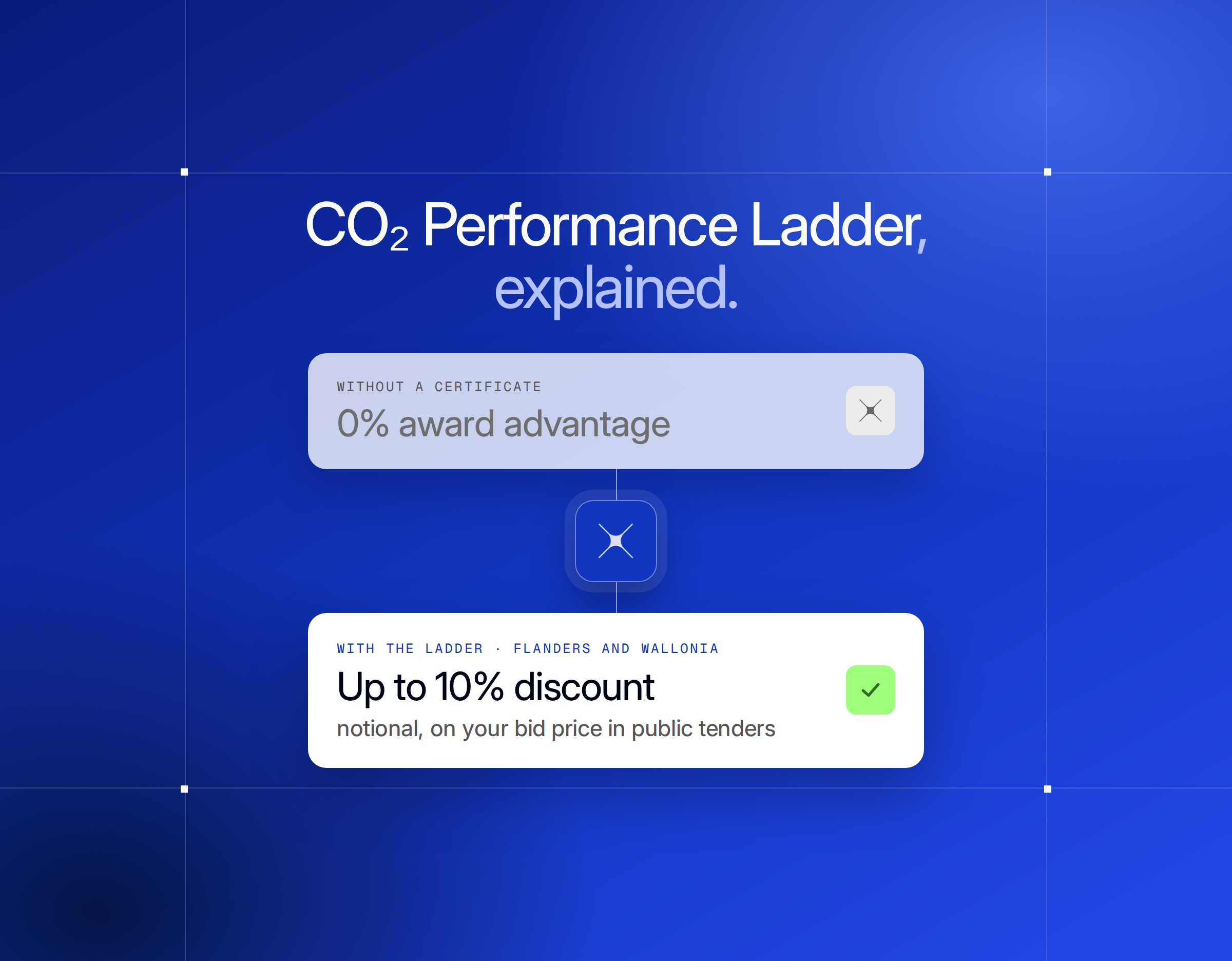
- Flanders already uses it since 2025 with bid price discounts up to 10%, and Wallonia follows from 2027 with its own rules
- SKAO's new Handbook 4.0 compresses five levels into three steps, with step 3 demanding a full net-zero transition path across scope 1, 2 and 3
- Certification requires solid data and documentation, which many companies still manage manually through spreadsheets and outside consultants each quarter
- An AI-driven platform can replace that manual, repeated work with one audit-ready dashboard
Introduction
The CO2 Performance Ladder originated in the Netherlands in 2009, as a tool to reward companies for concrete CO2 reduction in public tenders. Today the Foundation for Climate Friendly Procurement and Business (SKAO) manages the system: more than 8,000 organisations hold a certificate, and more than 300 contracting authorities use the ladder in their tenders. The ladder is now also active in Belgium, Germany, France, Ireland, Portugal and the United Kingdom.
For Belgian companies in construction and infrastructure, this is no longer an optional extra. Since 2025, the Flemish government has used the ladder as an award criterion for infrastructure works, and following the June 2026 announcement, Wallonia is following with its own track from 2027. In both regions, more contracts qualify every year.
What the CO2 Performance Ladder is
The CO2 Performance Ladder is a certification scheme and management system that helps a company map its CO2 emissions, set reduction targets, and structurally track progress. In the current version (3.1), the ladder has five levels, "from insight into your own CO2 emissions (level 1) to advanced reduction across the chain (level 5)." The higher the level, the more far-reaching the measures a company has to take and prove.
The emissions themselves follow the classification of the Greenhouse Gas Protocol (GHG), the international standard for this:
- Scope 1: direct emissions from sources you own or control. For a contractor: fuel for trucks, cranes and site equipment, natural gas or heating oil for heating.
- Scope 2: emissions from energy you purchase, mainly electricity.
- Scope 3: the rest of your value chain. Purchased materials, subcontractors, transport by third parties, waste.
Certification runs through an accredited, independent certifying body. After an introductory meeting and a proposal, a two-phase audit follows: first a review of the documentation and the management system, then an in-depth on-site assessment with interviews, process reviews and project visits. After the first audit, an annual surveillance audit follows, and a recertification audit every three years.
A financial benefit: the award advantage
What sets the ladder apart from a regular sustainability framework is its role in (public) tenders. Contracting authorities can attach a notional discount on the bid price to each ambition level. A company with a higher level gets an edge, even if it bids higher than a competitor without a certificate. The ladder itself is not a legal obligation however. It's the individual contracting authority that decides whether and how to use it as an award criterion or contractual requirement.
Handbook 4.0: from five levels to three steps
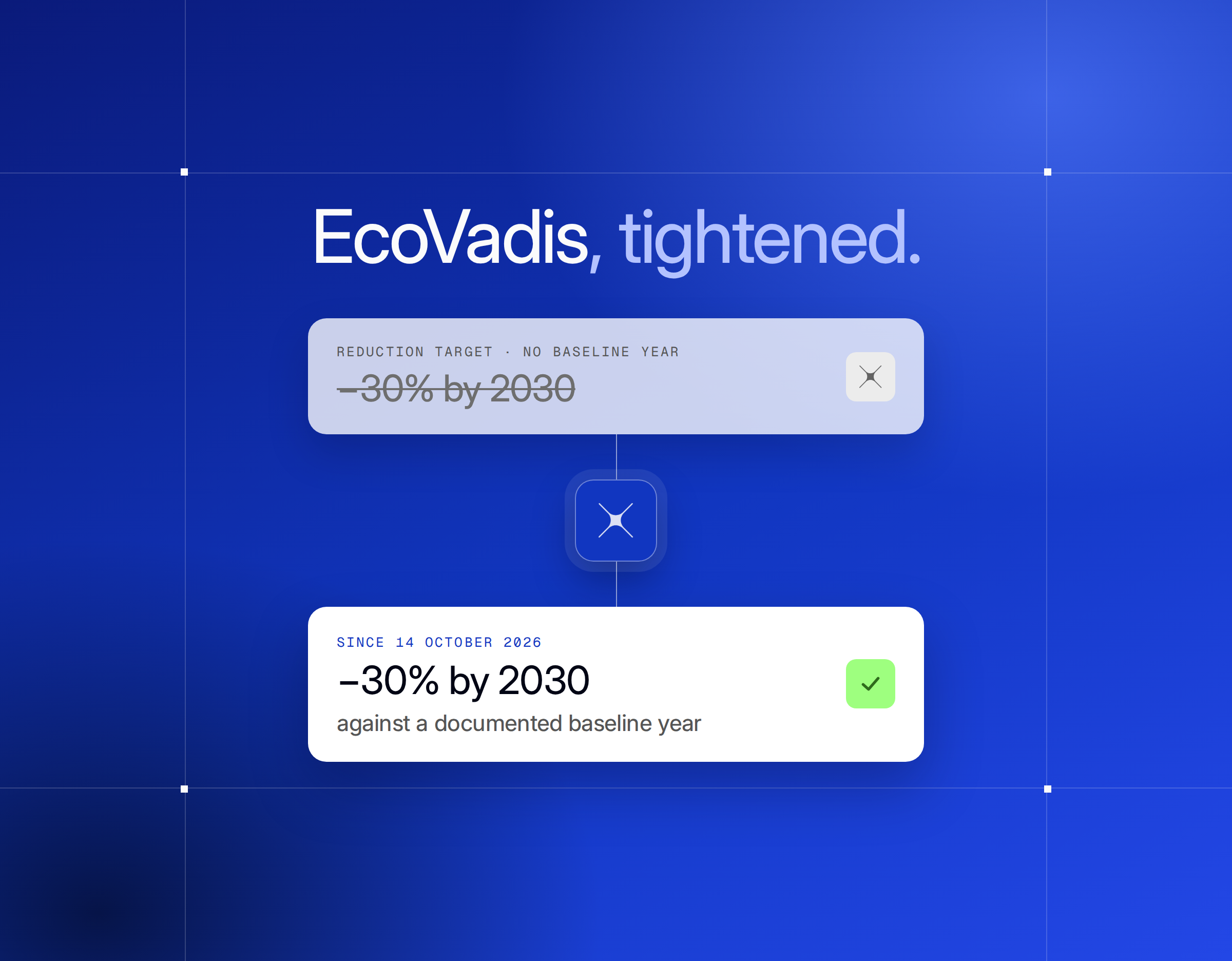
On 14 January 2025, SKAO published Handbook 4.0. The main change: the five levels make way for three steps. Step 1 largely corresponds to levels 1 to 3 of Handbook 3.1; step 2, and especially step 3, ask for considerably more ambition. Step 2 explicitly brings in the value chain (scope 3: materials, subcontractors, transport by third parties), step 3 requires a concrete transition path to net zero emissions by 2050 across scope 1, 2 and 3, plus what the handbook calls "other influenceable emissions."
The transition is gradual. The certification bodies that issue the ladder, have been allowed to carry out audits under Handbook 4.0 since 14 July 2025. Existing certificate holders must switch at the latest at their first audit after 14 January 2027; until then, Handbook 3.1 remains valid. A 4.0 certificate is also accepted in tenders still based on 3.1: step 1 of 4.0 is equivalent to level 3 of 3.1.
The Flemish service order, step by step
Since 25 April 2024, this has been laid down in service order MOW/MIN/2024/02 of the Mobility and Public Works policy area. The rationale comes with a figure: the policy area's investment projects currently emit about 766,000 tonnes of CO2 per year. The service order applies to the department itself and to Wegen en Verkeer (Roads and Traffic), Maritieme Dienstverlening en Kust (Maritime Services and Coast), De Vlaamse Waterweg, De Lijn, De Werkvennootschap, Lantis and LOM Vlaanderen. The rollout happens in three phases:
- Phase 1: investment contracts for works published from 1 January 2025, from 5 million euros (excl. VAT)
- Phase 2: from 1 January 2026, from 3 million euros (excl. VAT), this phase is already running
- Phase 3: from 1 January 2027, maintenance contracts included, from 1 million euros (excl. VAT)
Each ambition level comes with a fixed notional discount on the bid price:
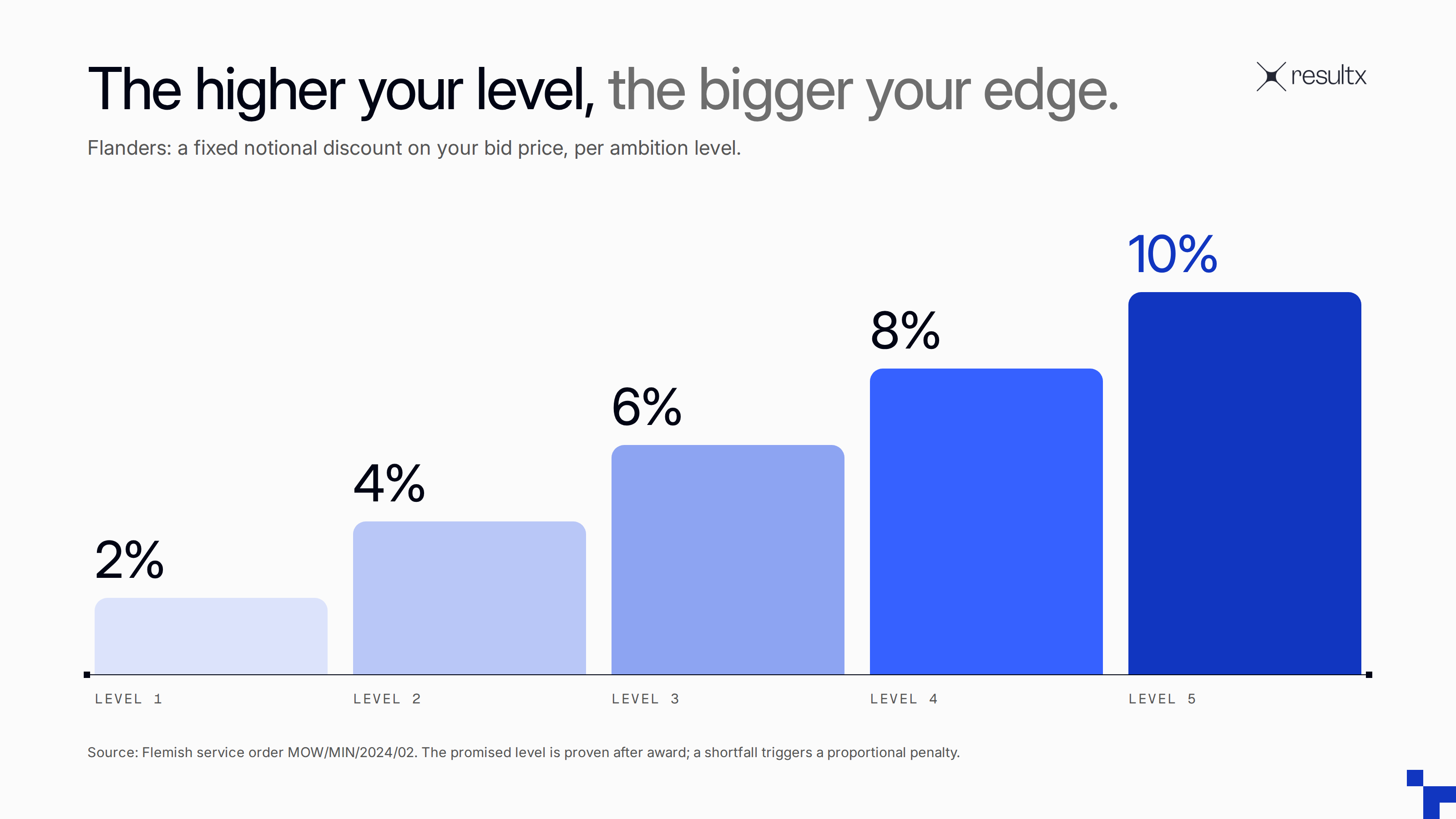
A bidder doesn't need to submit a certificate with the bid itself. It's enough to indicate the promised level on the bid form. Only after award does that level need to be proven: for contracts under a year, at provisional acceptance; for longer contracts, within a year of award and then annually thereafter. Anyone who fails to reach the promised level risks a financial penalty proportional to the shortfall. Framework agreements fall outside this regulation, and equivalent certificates from other, equally independent bodies are accepted.
And in Wallonia?
On 3 June 2026, it was announced that SPW Mobilité et Infrastructures (SPW MI) and SOFICO are introducing the Échelle de performance CO2 and additional "Impact CO2" criteria into their specifications, developed together with Embuild Wallonie and Mobiwall.
The scheme applies to contracts of class 4 through class 8, roughly from 600,000 euros, and rolls out in phases:
- 2027: a first step for classes 6 through 8
- 2028: extended to classes 4 and 5
- 2029: echelon 2 of the ladder mandatory for classes 4 through 7; for class 8, the contracting authority chooses between the ladder or the Impact CO2 criteria
The award advantage is 6% for echelon 1 and 10% for echelon 2 on the bid price. For the largest contracts (class 8), a contracting authority can instead choose the Impact CO2 criteria: an assessment of emissions per construction phase (installation, transport of materials and personnel, waste removal), independent of a certificate.
And in the Netherlands?
Rijkswaterstaat, one of the ladder's largest users, is switching its own tenders to Handbook 4.0 from 1 July 2026, for GWW (civil engineering) tenders published on TenderNed after that date. The notional discount is lower there than in Flanders, but scales with the step: 2% for step 1, 4% for step 2 and 6% for step 3. Anyone who fails to reach the promised level pays back 1.5 times the notional advantage. As in Flanders, a contractor gets up to a year after award to submit the certificate.
What a certification process asks for in practice
A certificate doesn't happen by itself. The scheme requires, among other things:
- a defined organisational boundary: which sites, legal entities and activities count, and from which base year;
- a complete emissions inventory covering scope 1, 2 and 3;
- concrete reduction targets and measures, each with an owner and a timeline;
- a management system for responsibilities, monitoring and communication;
- an internal audit and management review, followed by the external audit at the certifying body.
Where it most often goes wrong
At a large Belgian contractor already certified on the CO2 Performance Ladder, the data was spread across more than a hundred sources: invoices, photos of meter readings, energy exports, site spreadsheets. Every quarter, the company paid an external engineering firm to convert all of that into Excel sheets and charts. Not very scalable, and prone to errors.
Structure and repeatability matter here. In practice, that's still too often filled in with manual work that happens all over again every quarter.
How we approach that differently
For that contractor, we built an AI-driven platform instead. It reads every source directly, flags what's missing before a quarter is closed, and turns the result into one audit-ready dashboard, without an external engineering firm involved. Software that takes over the work. Scalable. No billed hours from a consultant you have to hire again every time. That makes it faster, cheaper and at a higher quality.
Frequently asked questions
Do I need to be certified to bid on a public contract?
In Flanders, you declare on the bid form which level you're offering; only after award do you need to prove it.
What happens if I don't reach the promised level?
The penalty mechanism from the contract documents applies: in Flanders, a financial penalty proportional to the shortfall; at Rijkswaterstaat, 1.5 times the granted notional advantage.
Does this also apply in Wallonia?
Yes, from 2027, with its own timeline and slightly different award percentages than in Flanders.
Does this apply outside public tenders too?
The ladder is primarily a tendering tool, but private companies also use the certificate to demonstrate their climate policy, independent of a specific contract.
What this means for you
A certification process takes time: gathering documentation, setting up a CO2 management system, going through the audit.
Working toward a certificate, or already certified and want to get off the quarterly Excel-and-external-firm treadmill? Feel free to book a call with us. We're happy to help.