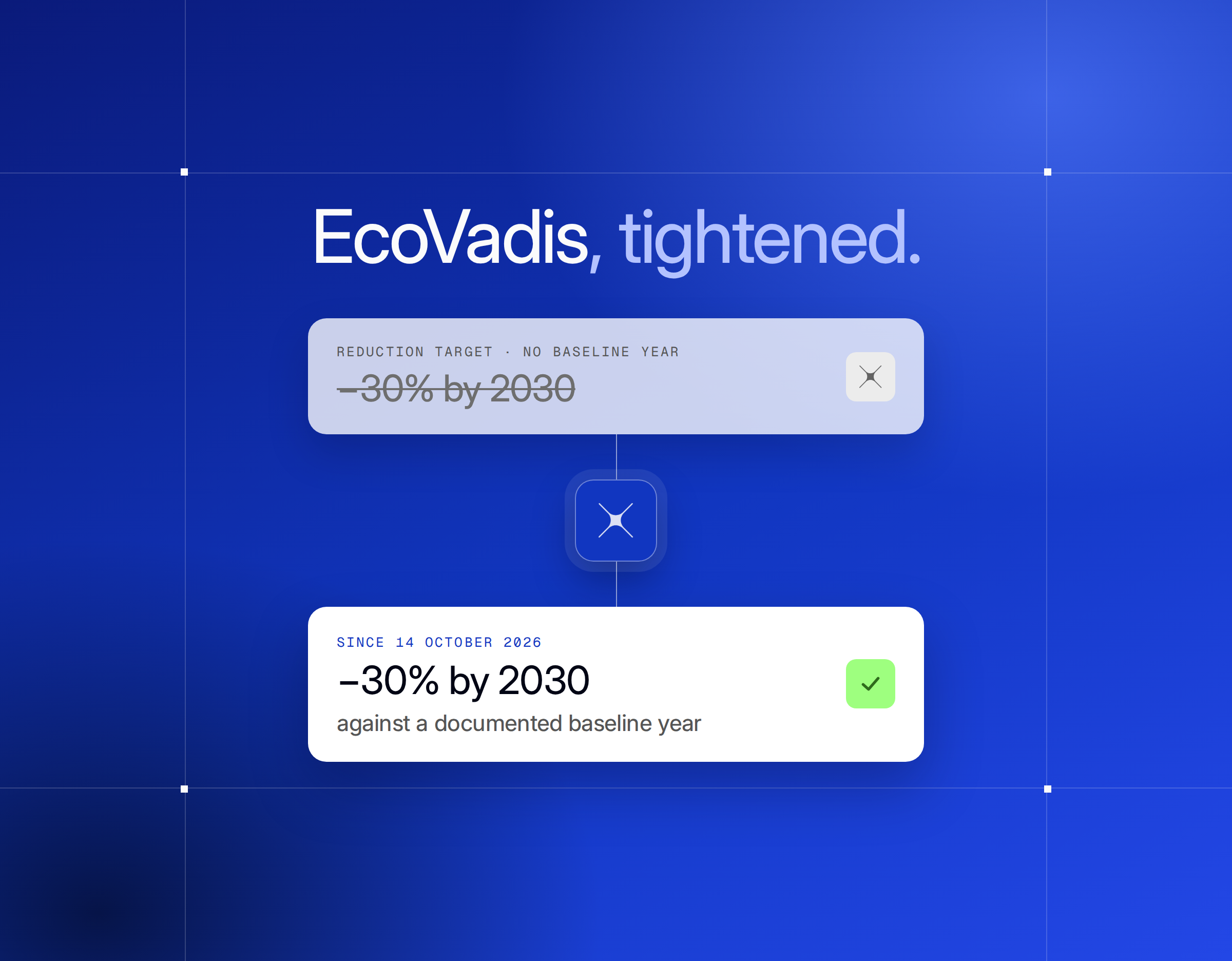
Did you recently submit a reduction target to EcoVadis without listing a baseline year? Since October 14 2026, it no longer counts.
EcoVadis has tightened its methodology again. If a client or bank is asking you for a score, now's the time to check your dossier.
No baseline year, no points
The main change: any quantitative reduction target you submit without a documented baseline year gets rejected. It no longer counts toward your Policy score.
Targets you already had approved remain valid until they expire. But anything you submit from now on needs a clear, substantiated starting point. "We want to cut emissions by 30% by 2030" without saying against which year is no longer enough.
Eleven new metrics
EcoVadis is also introducing eleven new standardized metrics, tied to their Key Sustainability Issues. They're aligned with GRI, ESRS, the voluntary VSME standard, and ISSB.
That's not a coincidence. EcoVadis is bringing its methodology closer to the reporting frameworks companies already have to, or want to, use. If your CSRD or VSME reporting is in order, you can reuse most of that data for EcoVadis.
And this already changed earlier this year
This October update doesn't stand alone. Earlier this year, EcoVadis already made several changes:
* Methodology disclosure documents per product, with version control and public consultations for major changes. A direct result of the EU ESG Rating Regulation.
* A mandatory choice between a location-based or market-based Scope 2 target (since May 2026).
* The Select Check-Up and the Score Drop outreach disappear for smaller Select companies (under 50,000 employees), since July 2026. Larger companies keep the Score Drop outreach.
Why this matters even more right now
Two developments make this update less optional than previous ones.
Since late 2026, EcoVadis itself is under the supervision of ESMA, the European securities markets authority, as a designated ESG rating provider under the EU ESG Rating Regulation. That's exactly why methodology changes now come with systematic version control and public consultation: EcoVadis itself has to account for how it calculates its scores.
At the same time, the CSRD simplification ("Omnibus", in force since early 2026) means far fewer companies now fall directly under the EU's mandatory reporting rules. Clients and banks that used to rely on their suppliers' CSRD reports are now looking elsewhere for that assurance, often to voluntary frameworks like EcoVadis and VSME.
What this means for you
Already have an EcoVadis score, or working toward one? Check now whether your targets have a baseline year, and whether your reporting is ready for the new metrics.
Curious what that looks like in practice? In our case with an industrial cleaning company, we took a lapsed EcoVadis score from 40 to 71, earning a Bronze medal, within one assessment cycle and four weeks from kickoff.