Last updated: 28 October 2026.
Of the roughly 50,000 companies that were preparing for mandatory CSRD reporting, estimates for how many actually fall under the law after Omnibus range from about 5,000 to 10,000, depending on the source and exact cutoff used, a cut of 80-90%. Quite the impact.
What the CSRD is, in short
The Corporate Sustainability Reporting Directive replaces the older NFRD, which covered roughly 11,000 European companies, mostly listed ones. The CSRD widened that circle considerably and sets out what you have to report, through the European Sustainability Reporting Standards (ESRS).
The starting point is double materiality. You assess two directions at once:
- Impact materiality: what impact does your company have on people and the environment?
- Financial materiality: which sustainability issues have a financial impact on your company?
Only what's material on at least one of those two axes needs reporting, with qualitative and quantitative data points. That includes your value chain: suppliers and customers count too.
Do you fall under the CSRD? Today's threshold
This is by far the part that's changed most, and where most of the confusion sits.
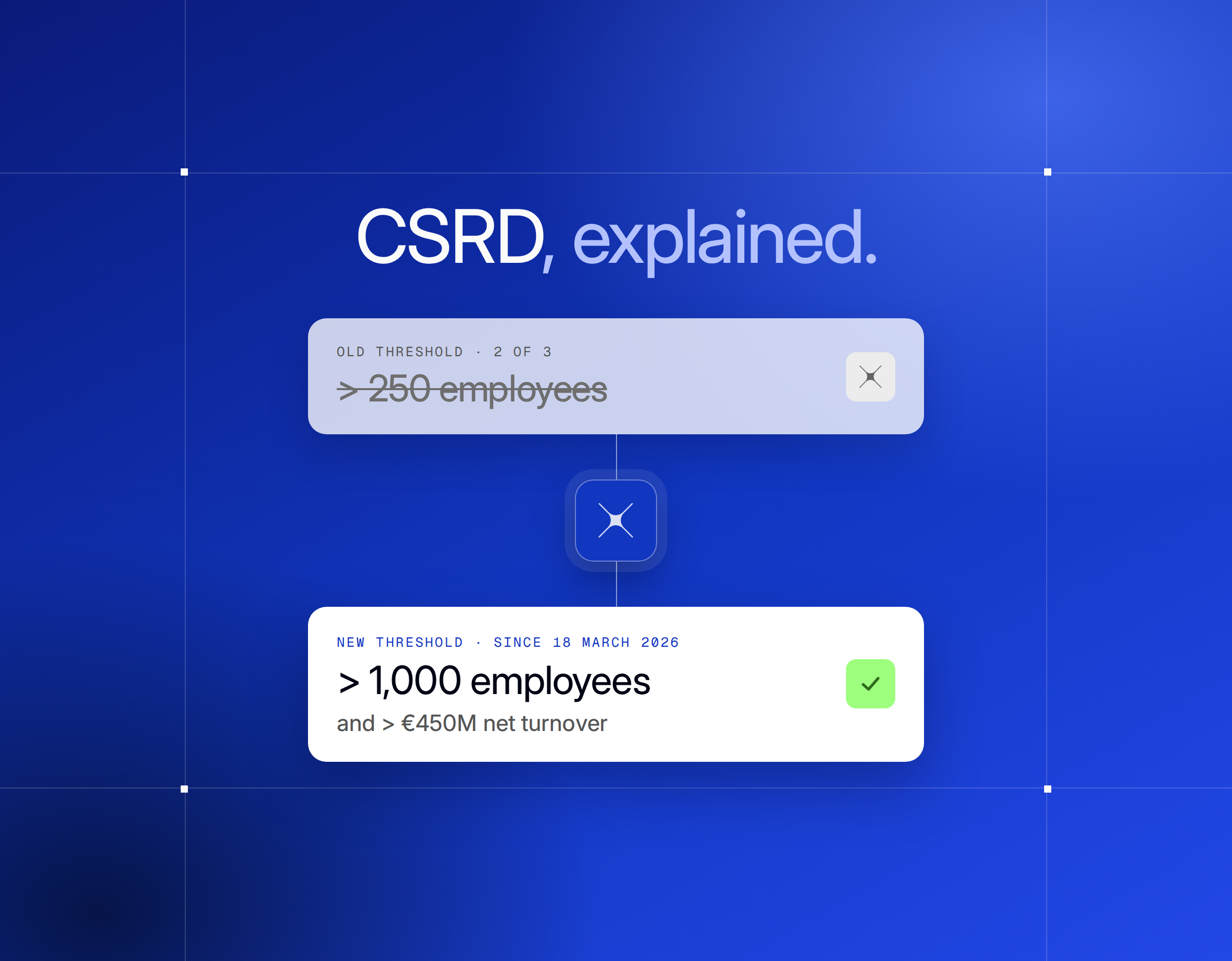
The old threshold (the "large undertaking" definition from the Accounting Directive): exceed at least 2 of the following 3 criteria, on two consecutive balance sheet dates: a balance sheet total of €25 million, a net turnover of €50 million, or an average of 250 employees (FTE).
The threshold since 18 March 2026, via Article 19a of the Accounting Directive as amended by Directive (EU) 2026/470: that 2-out-of-3 test is gone. A company or group only falls under the CSRD if it exceeds both of the following at once:
- an average of more than 1,000 employees (FTE);
- a net turnover of more than €450 million.
The balance sheet total no longer counts as a standalone criterion. For non-EU groups: a net turnover of more than €450 million generated in the EU, for each of the last two consecutive financial years, plus an EU subsidiary or branch with a net turnover of more than €200 million in the preceding financial year.
Group exemption: if the parent company publishes consolidated sustainability information for the whole group, a subsidiary doesn't need to publish its own report.
The waves, with current (delayed) timing
| Wave | Who | Reporting on financial year | First publication |
|---|---|---|---|
| Wave 1 | Large public-interest entities, >500 employees (former NFRD companies) | 2024 | 2025 (already underway) |
| Wave 2 | Large companies above the new threshold | 2027 | 2028 |
| Wave 3 | Listed SMEs | 2028 | 2029 |
Wave 1 got no delay. Waves 2 and 3 each moved two years later via the stop-the-clock directive (see timeline). Note: part of wave 1 that now falls below the new, higher threshold - public-interest entities with more than 500 but no more than 1,000 employees, and turnover under €450 million - could be exempted in Belgium from financial year 2026 onward. As of our last check (October 2026), that track was still with the Council of State for advice, with conflicting reports on whether the exemption would cover financial year 2026 only or the years after it too, and it had not yet had a final vote in the Chamber (see timeline). Check the current status on dekamer.be before you plan around it.
Which standards apply
The ESRS consist of 12 standards:
- 2 cross-cutting standards, mandatory for everyone: ESRS 1 (general requirements and methodology) and ESRS 2 (general mandatory disclosures, regardless of materiality).
- 10 topical standards: E1 through E5 (environment), S1 through S4 (social), and G1 (governance). Which of these apply depends on your double materiality assessment.
Sector-specific standards, originally planned per sector (oil and gas, textiles, agriculture, banking, and so on), are off the table under Omnibus I. EFRAG may still work on voluntary sector guidance, but its form and timing aren't set. The separate, mandatory standard for listed SMEs (LSME) has also been scrapped.
On 3 July 2026, the Commission adopted a simplified version of the 12 existing ESRS, based on EFRAG's 3 December 2025 advice: roughly 60% fewer mandatory data points, and all optional data points dropped entirely. That text cleared scrutiny in the European Parliament and Council without objection and was published in the Official Journal on 21 September 2026 as Commission Delegated Regulation (EU) 2026/1563. It enters into force on 10 November 2026 and is mandatory from financial year 2027; companies starting a 2026 financial year can already choose the new, simplified standards instead of the existing ESRS.
Assurance and publication in Belgium
- Assurance: limited assurance only, carried out by your statutory auditor or another company auditor (bedrijfsrevisor), appointed by the general meeting for a renewable 3-year mandate. The planned escalation to "reasonable assurance" was removed from the directive under Omnibus I; whether and when it comes back depends on a feasibility assessment the Commission hasn't concluded yet. An EU assurance standard for limited assurance is due no later than 1 July 2027.
- Publication: in the annual report, via the National Bank's Balance Sheet Office (Balanscentrale), and on your own website. A European single access point (ESAP) is meant to make this searchable EU-wide over time.
- Language: the official language of your registered office. Other EU languages are allowed as a supplement.
- Safe harbour: the management body may, as with annual accounts, exceptionally omit information about impending developments or ongoing negotiations if disclosure would seriously harm the company's commercial position, provided this doesn't prevent a true and fair view of the situation. Belgium kept this option in its transposition.
- Sanctions: no separate CSRD penalty regime. Breaches follow the existing enforcement and sanctions framework for annual accounts and statutory audit.
Out of scope? The value-chain cap and VSME
Fall outside the CSRD, but supply a company that's in scope? You'll get asked regardless of your own obligations. Two things matter here.
The value-chain cap itself has been settled since 18 March 2026, built into the Omnibus I directive: a CSRD-obligated group can't ask a supplier or customer with 1,000 employees or fewer for more information than the Voluntary Standard covers. What exactly that standard requires was only pinned down later, by Commission Delegated Regulation (EU) 2026/1560 (see below).
VSME (Voluntary Standard for non-listed SMEs) got its technical advice from EFRAG on 17 December 2024, and was recommended by the European Commission as the reference point on 30 July 2025 (Recommendation (EU) 2025/1710), non-binding at the time. The delegated act that formally establishes it as the standard for the value-chain cap is now final: the Commission adopted it on 3 July 2026, it cleared scrutiny in the European Parliament and Council without objection, and it was published in the Official Journal on 21 September 2026 as Commission Delegated Regulation (EU) 2026/1560, now officially the "Voluntary Standard" (VS), still built on the EFRAG VSME framework. It entered into force on 24 September 2026, it's no longer a non-binding recommendation but directly applicable EU law, and the value-chain cap it underpins applies to CSRD reporters from financial year 2027. There's no assurance requirement on a VS/VSME report.
In practice: a VSME report is only worth doing once you're actually getting questionnaires from customers, banks or tenders. It's not a precautionary CSRD-lite.
The full timeline
- Late 2022 – July 2024: the CSRD enters into force, member states transpose it.
- 2 December 2024: Belgium's transposition act, including the safe-harbour clause, published in the Belgian Official Gazette on 20 December 2024. Wave 1 starts reporting on financial year 2024.
- 26 February 2025: the European Commission proposes the Omnibus I package.
- 3-16 April 2025: the "stop-the-clock" directive moves through Parliament, Council and publication. Wave 2 moves to financial year 2027, wave 3 to financial year 2028.
- 3 December 2025: EFRAG finalises its technical advice on simplified ESRS and hands it to the Commission.
- 4-23 December 2025: Belgium transposes the stop-the-clock directive (act of 12 December 2025, Belgian Official Gazette 23 December 2025).
- 24 February – 18 March 2026: the substantive Omnibus I changes get final approval, are published (Directive (EU) 2026/470) and enter into force. New threshold (1,000 employees + €450 million turnover), the dropped escalation to reasonable assurance, the value-chain cap.
- 27 March 2026: Belgium's Council of Ministers approves a first preliminary draft bill that would exempt wave-1 public-interest entities with 500–1,000 employees (and turnover under €450 million) from reporting, starting with financial year 2026.
- 3 July 2026: the Commission adopts both the simplified ESRS and the delegated act establishing the Voluntary Standard (VS/VSME) for the value-chain cap. Both go to the European Parliament and Council for scrutiny.
- 18 July 2026: the Council of Ministers approves a broader draft bill anchoring the new Omnibus I threshold in Belgian law; at that point it still needed advice from the Council of State.
- 11 September 2026: per the Gibson Dunn CSRD transposition tracker, Belgium's status is still limited to the original CSRD transposition (2 December 2024) and the stop-the-clock transposition (23 December 2025) — no wave-1 exemption or Omnibus I threshold law shows up yet.
- 21 September 2026: both the simplified ESRS (Commission Delegated Regulation (EU) 2026/1563) and the Voluntary Standard/ex-VSME (Commission Delegated Regulation (EU) 2026/1560) clear scrutiny without objection and are published in the Official Journal.
- 24 September 2026: the Voluntary Standard (ex-VSME) enters into force.
- 10 November 2026: the simplified ESRS enter into force.
What's still to come
- The final vote on Belgium's full transposition law for the remaining Omnibus I provisions, in parliament by 19 March 2027 at the latest. That includes the open question of whether, and from exactly which financial year, part of wave 1 gets exempted under the new threshold.
- The EU assurance standard for limited assurance, expected by 1 July 2027.
The simplified ESRS and the Voluntary Standard (ex-VSME), meanwhile, are final: both are published in the Official Journal and in force (see timeline). None of the remaining points still change the overall direction. We'll update this guide as soon as something concrete changes.
What this means for you in practice
- Check first whether you still fall in scope. The threshold now sits at 1,000 employees and €450 million turnover, cumulative. Plenty of companies that were preparing two years ago now simply fall outside it.
- Out of scope, but supplying companies that are? A VSME report is the pragmatic step, once you're actually asked for one. Not a full CSRD process you don't actually need.
- Still under wave 1, 2 or 3? Use the extra time to build it properly with what you already have, rather than waiting for every detail of the simplified ESRS to be finalised. The headline, far fewer data points, limited assurance only, is settled enough to start on now.
One more thing worth keeping in mind: none of this makes the underlying pressure disappear. The value-chain cap sounds tidy on paper, but in practice it's hard to monitor and even harder to enforce - nothing stops a bank, an insurer, a customer or a tender committee from simply asking for more than the Voluntary Standard covers, and plenty already do. Independent of CSRD and Omnibus altogether, the demand for structured sustainability data keeps growing from other directions: EcoVadis assessments, the CO2 Performance Ladder, banks and insurers folding climate risk into their own reporting and lending decisions, tender procedures that score sustainability alongside price, and supplier questionnaires from customers. Whether or not the law applies to you directly, having your sustainability story and the data behind it properly structured is simply the stronger position to be in - pragmatically, though: proportional to what's actually being asked of you, not a full CSRD-grade build-out you don't need.
Wondering whether you still fall under the CSRD after all these changes, and what that means in practice?
Book a 30-minute call with our sustainability experts. We're here to help.