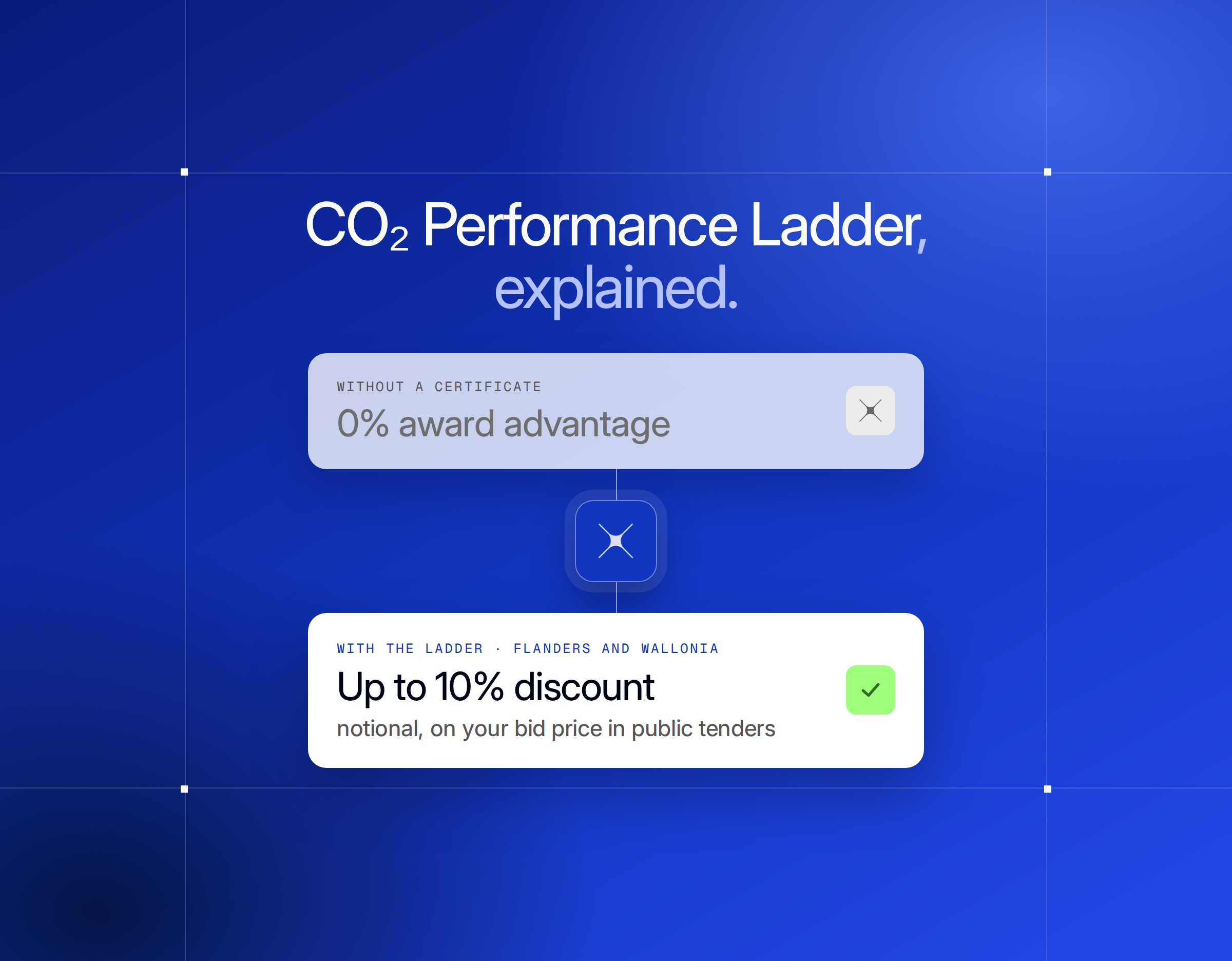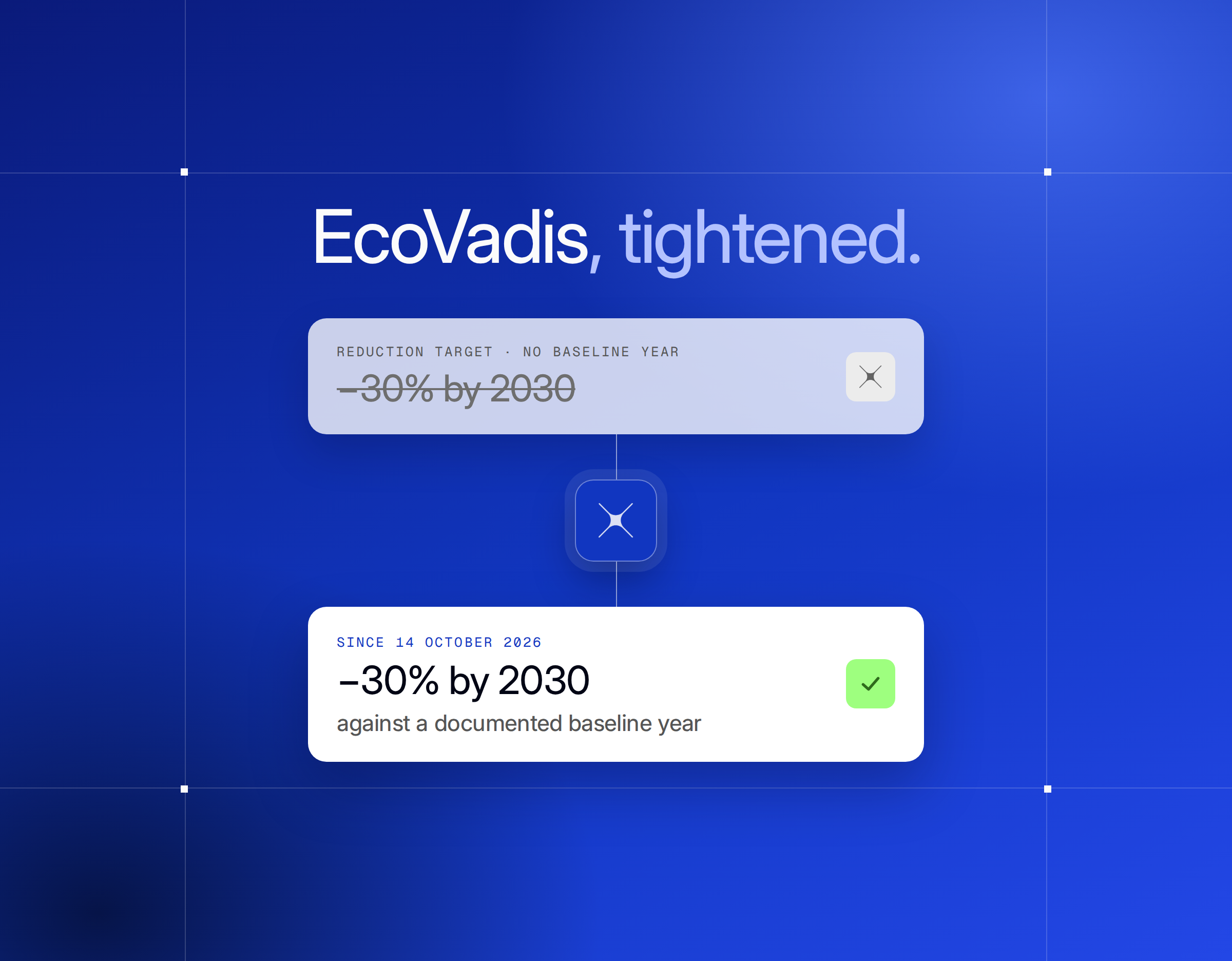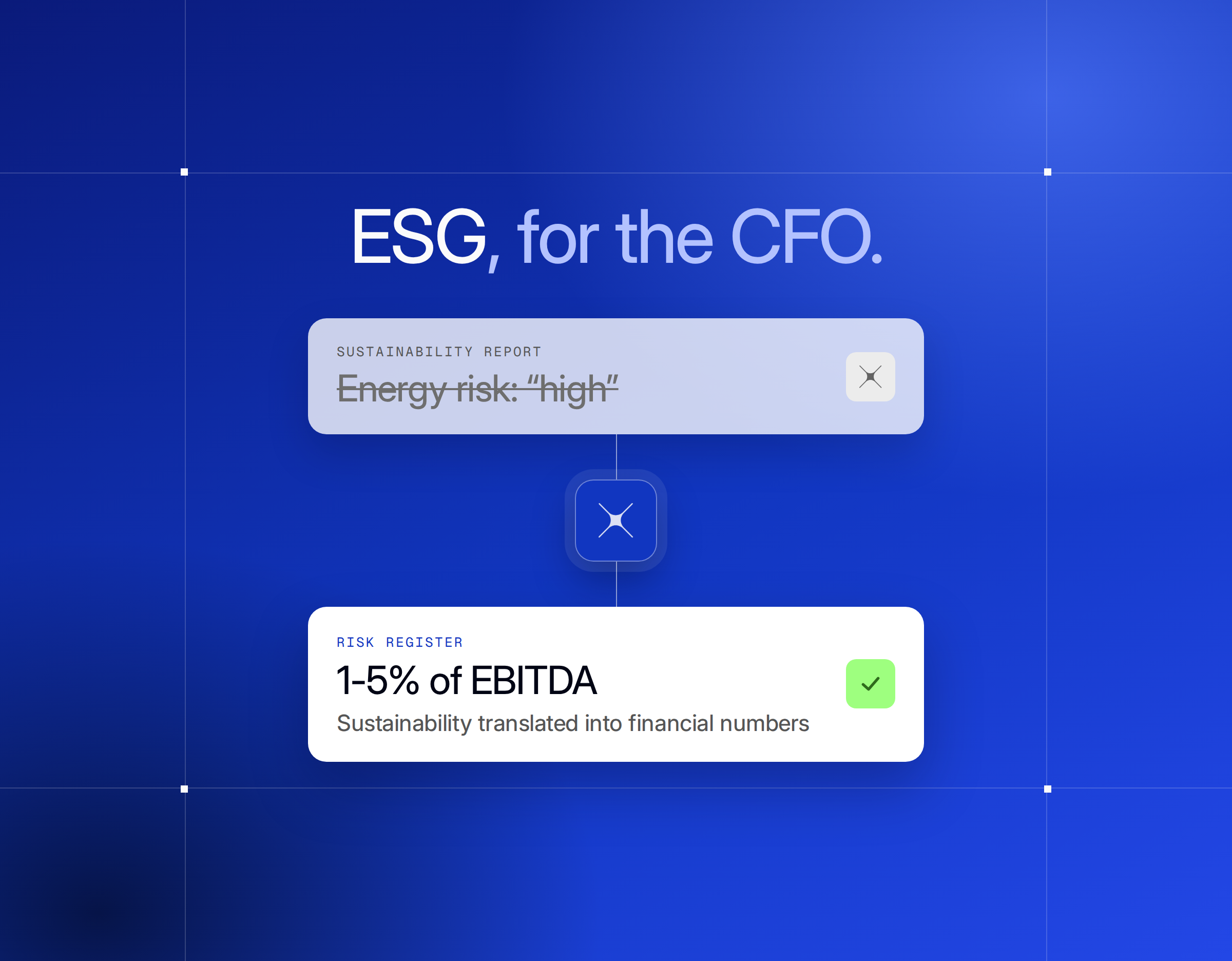
The majority of European companies will face more sustainability demands in the years ahead: reporting frameworks like CSRD and CO2 Performance Ladder, questions from clients and banks, EcoVadis assessments, pressure from their own sector and more. And currently, those companies have only three options to deal with this.
Three options, none of them built for the result
Option one: handling it internally. That means either training your own people in a field that keeps on changing or hiring extra people with niche expertise. Both routes cost a lot of time and money, with no guaranteed results.
Second route: you hire an external consultant. The problem: those consultants often still work with manual processes that have been made obsolete by the current technological revolution. On top of that, they bill by the hour, which only drives up the invoice. Once the report is delivered, execution and follow up land back on your desk.
The third option is for the more tech-savvy companies: buy a software license, hoping it automates most of the process. However, sustainability has too many complex facets for just one tool, so you end up buying additional ones. Or worse: the software itself is that complex, that you still need to pay a consultant who works alongside the vendor. Again, more costs and more pressure on your own organization.
Together, these three options only reinforce the perception of sustainability as a compliance-driven cost. Especially because none of the three ever asks the right question: how does this make my company financially stronger?
How do we fix this? Don't treat software and advisory as two separate purchases, but combine them into one. A single partner that builds the technology, tailored to your company, and if needed, delivers the service on top of it. Value-driven, fixed price.
Our thesis: software that dissolves itself into a service
A new generation of companies is doing today what seemed impossible ten years ago: building the software, and delivering the service themselves, under the same roof. Made possible by AI that no longer just helps a human but does the heavy lifting itself and delivers the result, that is checked and validated by an experienced expert. "Services as software" is what this is now being called: the software doesn't disappear, it dissolves into the service it delivers.
For the client, the main advantage is no longer having to find and pay two or three vendors to reach the same result. One party, one accountability, and one invoice for the end result. We see that same pattern returning today in every sector that used to need both a license and an expensive consultant: consulting, accounting, insurance brokerage. No sector escapes this, sustainability included.
Why billable hours are done
The same pattern shows up everywhere you look: companies no longer selling a license to a service provider, and no longer billing by the hour, but delivering the result themselves, for a fixed price.
That's not a coincidence. Billable hours reward time, not outcome. The more efficiently AI handles a case, the less there is to bill. Every efficiency gain AI delivers undercuts their own revenue model. An advisory firm that bills by the hour has no structural incentive to use the very technology it recommends to clients.
A software company that only sells a license has no grip on the quality of the outcome either: it delivers the tool, not the result. And whoever sells efficiency as the product is, in effect, selling the replacement of people: the better the tool, the fewer people a client still needs to do the same work. That's an uncomfortable message for a vendor to bring to its own client.
Only a company that owns both, the software and the delivery, can turn AI's efficiency gain into a better result for the client, at a lower price, without destroying its own revenue model and without confronting the client with a product that makes their own people redundant. That's the whole point. Outcome, not hours. It's even in our name.
What does this have to do with sustainability?
That same thesis seeps into sustainability itself. KanataQ, a market intelligence firm tracking more than 400 ESG and sustainability solution providers across 48 countries, mapped it out in "The State of Sustainability Solutions." Of those 400+ providers, 74% are software-only, 18% blend software with advisory, and 8% are advisory-only. But the report's conclusion is unambiguous: "Advisory-augmented software solutions outperform pure SaaS, especially in complex areas like LCA and CSRD reporting." Providers that have both software and advisory in-house perform better than pure-SaaS players, precisely on the complex files that matter. Even KanataQ's own recommendation to software vendors reads: "Blend tech with advisory support."
That picture holds outside the sector too. Verdantix surveys hundreds of sustainability leaders worldwide every year, and finds the two big budget lines, software and consultancy, aren't competing but growing together. Even Watershed, one of the best-known pure-software players in carbon management, partnered with Deloitte Netherlands in 2025, specifically to add an advisory layer alongside its platform. Software alone isn't enough. The buyers feel it, the research says it, and even the pure-software players themselves have come to see it.
Sustainability pays off, if you handle it right
And that's exactly the problem with the three options most companies use to tackle sustainability today. They make people think that sustainability is a compliance-driven cost. However, sustainability does pay off financially, that much is now established. Gharbi et al. surveyed 250 companies listed on the London Stock Exchange in the International Journal of Law and Management, over ten years, covering 2,500 observations. Their finding: a higher ESG score correlates with higher market value, even after correcting for size, debt and profitability (correlation 0.42, β = 0.089, p < 0.05).
Notably: the average ESG score in that study is 20 out of 100, while the frontrunners score 74. The large difference between these companies translates into market value. But as long as companies are stuck in the three routes described above, the difference will remain. Not because sustainability doesn't pay off, but because the way it's being handled today is exactly what gets in the way of achieving that value.
That's why this is our mantra at ResultX
For you, as a company, this mostly means one thing: you no longer have to choose an expensive consultant, a complex standalone license, or the risk of figuring it out yourself. We build the software and deliver the service, under one roof, through three models:
* Project, fixed price, fixed delivery date, no billing by the hour.
* Module and license, for those who want to keep doing the work themselves: a license on our software, with our own sustainability experts' guidance on top. Never a bare tool without advice.
* ESG-as-a-Service, our senior experts at a fixed monthly fee, with defined KPIs, acting as your external sustainability team supported by the latest technology.
Why you pay for the result, not the hours
That's exactly why this is more valuable to you than the rest of the market. With a classic advisory firm, you pay for time, not for outcome: the slower the process, the higher the invoice. With a software vendor, you buy a license, but nobody guarantees you'll actually become more sustainable and financially stronger because of it. With ResultX, you pay for the result itself: we have just as much interest as you do in reaching it as fast and as well as possible. Every efficiency gain AI gives us translates for you into a better result at a lower price. Not into a higher invoice, and not into profit that stays with us.
A partner that grows with you
Technology and the sustainability landscape are changing so fast nowadays. And that's exactly why having an end-to-end partner, one that has both the advisory and the software in-house, matters more today than ever. That way, you simply scale along: we keep up with the technological evolution and regulation, and you benefit from that automatically, without having to shop around, run a tender, or re-evaluate vendors yourself.
That same technological revolution lets us build more tailored towards your company, instead of one generic tool for everyone. That makes us more than just a vendor you bring in for one report, it makes us a sustainability partner that grows with you, for the long term. One that unlocks the financial value of sustainability.
Curious what that looks like for your company? Our experts are happy to help.